
Everything else in this documentation is a detail of the story below. Read this page first; the rest will make sense afterwards.
The one-sentence version
Legacy Wallet is an ordinary Solana wallet that also keeps a heartbeat recorded on the blockchain — and if that heartbeat stops for long enough, a person you named can inherit what you set aside for them.
The three parts
1. A wallet. Non-custodial, biometric, on your phone. Keys are generated on the device and stored in hardware-backed secure storage. You send, receive, swap and hold SOL, SPL tokens and NFTs. Nothing about inheritance affects everyday use.
2. The Switch. A small program running on Solana holds your inheritance settings: who your heir is, how long you can be silent, and how long they must then wait. Opening the app resets the clock.
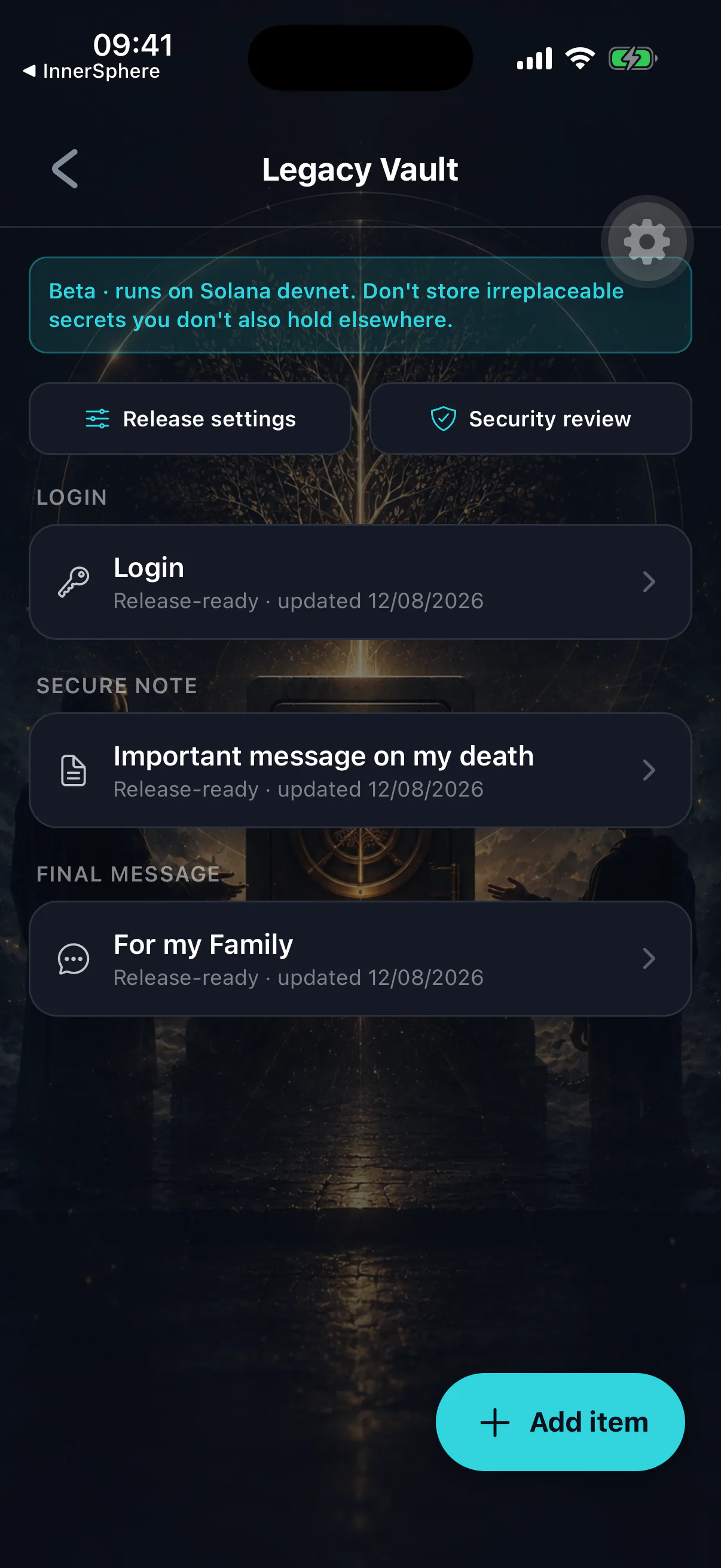
3. The Legacy Vault. Encrypted storage for the things a blockchain cannot hold — logins, documents, instructions, final messages. Encrypted on your phone before it leaves, and readable by your heir only after a claim has finalized.
Beta status
Inheritance and the Legacy Vault currently run against Solana devnet while the system is tested end to end. Devnet SOL has no monetary value. Do not treat the current build as a place to store assets you cannot afford to lose.
The setup, once
- 01
Create or import a wallet
A new wallet is generated on your device, or you import an existing recovery phrase. The phrase never leaves the phone and is never sent anywhere.
- 02
Name an heir
You enter one Solana address — the person who should inherit. They cannot see anything, touch anything, or learn anything yet.
- 03
Your heir accepts
Your heir signs a one-off confirmation from their own wallet. Until they do, no claim is possible at all. This is what stops a mistyped address from ever inheriting anything.
- 04
Choose a timer
How long you may be silent before a claim can begin, and how long the challenge window then lasts. One year with a seven-day challenge is the recommended pairing.
- 05
Deposit what should pass on
Assets are inherited only if you deposit them into the inheritance vault. Whatever stays in your ordinary wallet balance stays yours and is not part of the estate.
- 06
Fill the Legacy Vault
Add the logins, files, instructions and messages your heir will actually need. Each item is encrypted on your device before it is stored.
Living with it
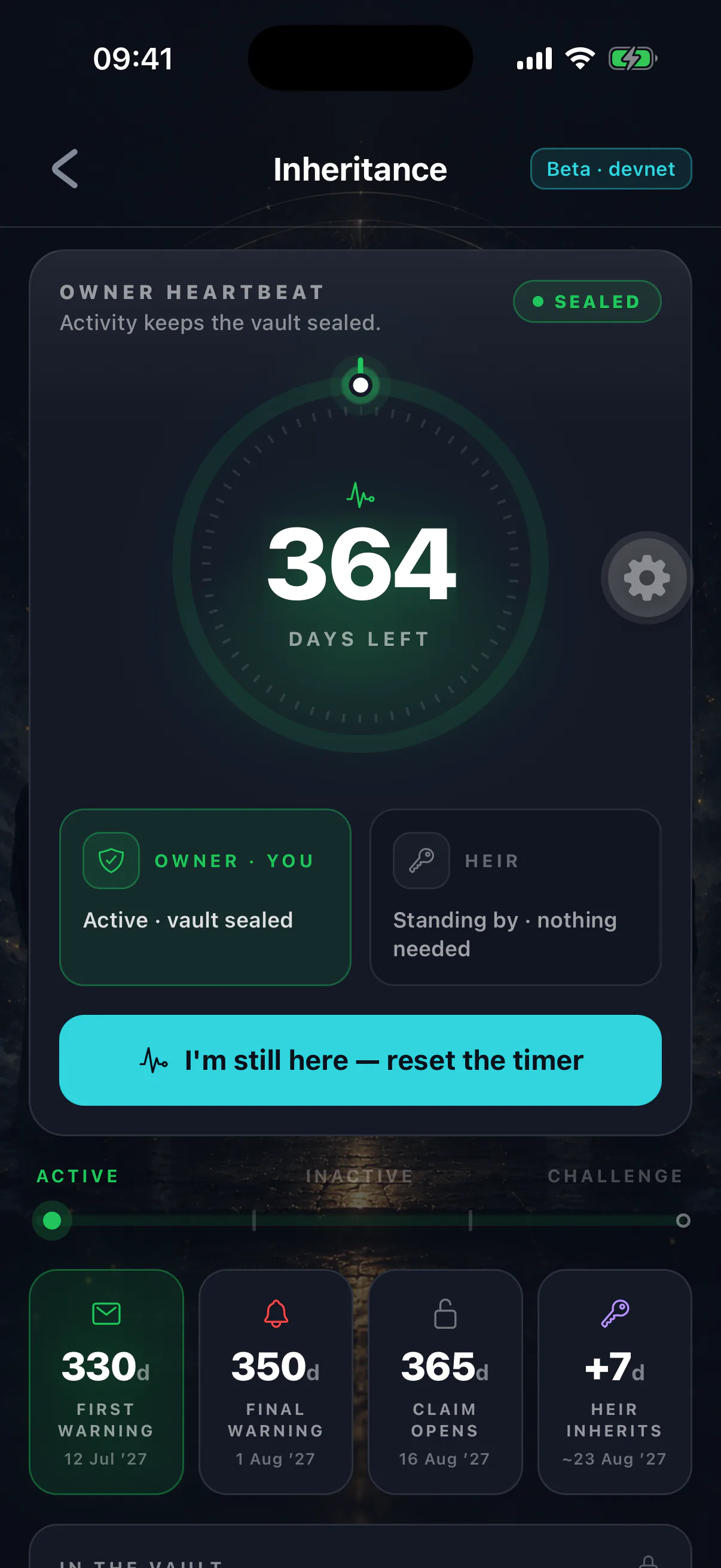
Opening the app is the whole maintenance routine. Each time you do, the wallet writes a fresh heartbeat to the chain and the clock restarts from zero.
If you go quiet, you get warned twice before anything can happen — at roughly 90% and 96% of the way through your timer. On a one-year timer that is around day 330 and day 350.
Default one-year configuration
- Inactivity timer
- 365 days from your last activity
- First warning
- ~day 330
- Final warning
- ~day 350
- Heir may start a claim
- Day 365
- Challenge window
- 7 days, during which you can cancel
- Transfer possible
- Day 372 at the earliest
If the timer ever runs out
Your heir opens the app and starts a claim. That does not transfer anything — it opens the challenge window.
During the challenge window you can cancel by doing anything at all with the wallet. A heartbeat, a transaction, a settings change: any owner activity clears the claim and resets the full timer. One tap undoes the whole year.
If the window closes with no sign of you, your heir finalizes the claim. Only then can they withdraw the deposited assets, and only then does the vault become readable to them.
It takes two mistakes to go wrong
For an accidental inheritance you would have to miss both warnings and the entire challenge window, having not opened the app once in over a year.
What the heir actually receives
- Deposited SOL. What you placed in the inheritance vault. SPL tokens and NFTs cannot be deposited yet.
- The Legacy Vault. Every item you scoped to your heir, decrypted on their device once the claim is finalized on-chain.
They do not receive your recovery phrase, your device, or control of your wallet. They receive an estate, transferred to their own wallet.
Who enforces all this
The rules live in a program on Solana, not on our servers. The timer is measured by the blockchain's own clock. The conditions for a claim are checked by the program every time, on every attempt. There is no admin button that releases an estate early, because there is no admin.
Read where your keys live and what we cannot do for the full trust model, including the parts we are still hardening.
Where to go next
- Setting it up: Setting up the Switch
- The vault: What the Legacy Vault is
- You were named: You have been named an heir
- The honest limits: Known limitations