
Crypto is rarely the hard part of an estate. The hard part is everything the chain cannot carry: the exchange account, the password to the laptop, where the hardware wallet actually is, and what you wanted to say.
The Legacy Vault holds that, under the same condition as the assets.
How it behaves
- Items are encrypted on your device, before anything is stored.
- What is stored is ciphertext. It is not readable by the storage, by us, or by anyone who obtains a copy of it.
- You can read your own items at any time while your wallet is active.
- Your heir can read the items you scoped to them only after an inheritance claim has finalized on-chain — the same finalization that releases the assets.
- The release check is made live, every time. If you return and cancel a claim, the vault re-seals immediately.
Titles and categories are not encrypted
An item's title and category are stored in the clear so lists can be shown — to you, and in preview to your heir. Never put a secret in a title. Call it “Bank login”, not “Barclays 0429 — password Hunter2”. See what your heir sees before release.
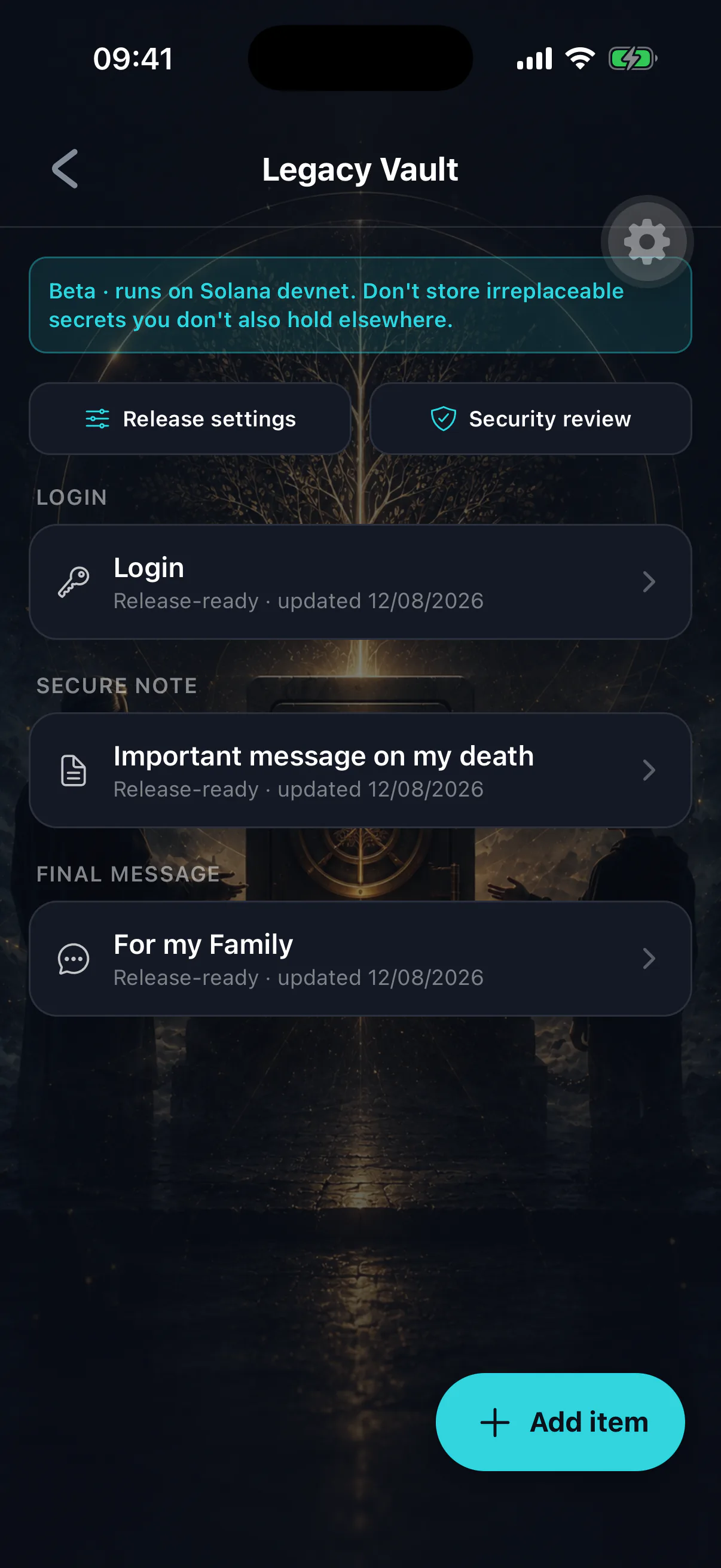
What belongs in it
Anything your heir would need and cannot get from the chain:
- Account logins, recovery emails and backup codes.
- Where physical things are — hardware wallets, safes, documents, keys.
- Instructions: what to sell, what to keep, who to call, in what order.
- Files: scans, deeds, policies, photographs.
- Recovery phrases for wallets this app cannot escrow, such as Bitcoin.
- The message you would want them to read.
See vault item types for how each is handled.
What does not belong in it
Your Legacy Wallet recovery phrase. The app refuses this deliberately — that phrase re-derives the key that protects the vault itself, so storing it inside would be circular and would expose every item, including private ones.
Anything that must never be released. Scope it owner-only if you want to keep it in the vault for yourself, and understand that scope is the only thing standing between the item and your heir.
The trade being made
The vault is genuinely encrypted end to end, but it is not the same trust model as the on-chain assets. Releasing a decryption key to an heir requires more than a program can do alone, so the design splits key material across several parties and gates reassembly on the finalized on-chain state.
Read how the vault is encrypted for the mechanism, and known limitations for the parts we are still hardening. An inheritance product that is vague about this is not worth trusting, so we are not.
Getting started
Add your first item — the one thing your heir would be stuck without. See adding your first vault item.