
There is one thing to understand here, and getting it wrong is the most common and most expensive mistake in the whole product.
Only deposited assets are inherited
Your heir does not inherit “your wallet”. They inherit what you explicitly deposited into the inheritance vault. Anything sitting in your ordinary balance when you die stays exactly where it is, unreachable by anyone.
The two things that pass on
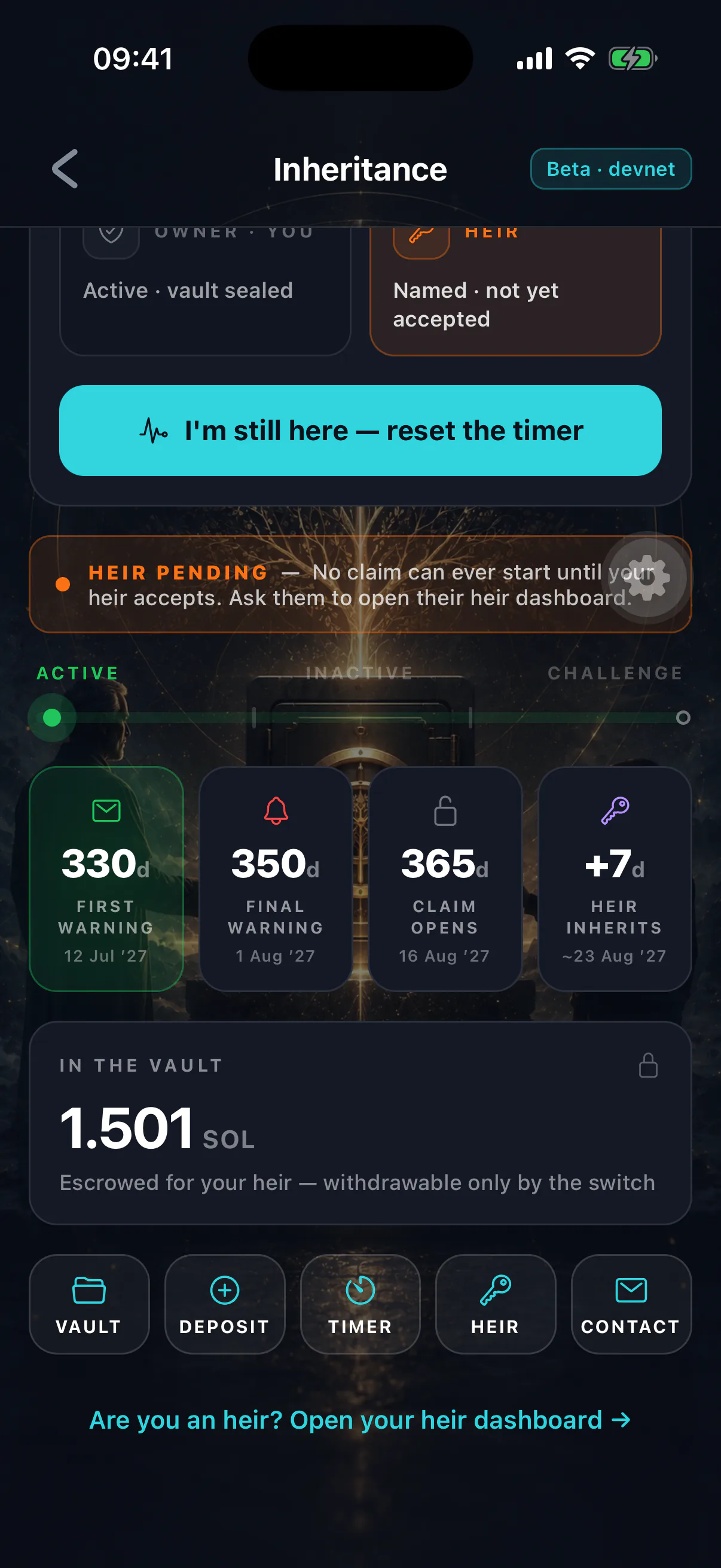
1. Deposited SOL. What you moved into the on-chain inheritance vault. Once a claim finalizes, your heir withdraws it to their own wallet. SPL tokens and NFTs cannot be deposited yet, so they are not part of the estate today. See depositing assets for your heir.
2. The Legacy Vault. Every item you scoped for release — logins, notes, files, links, instructions, final messages, contacts. Decrypted on their device once the claim is finalized on-chain. See release settings and scope.
What does not pass on
- Your undeposited balance
Stays at your address. Nobody can move it without your key.
- SPL tokens and NFTs
Not yet depositable, so not inherited. Cover them with vault instructions.
- Your recovery phrase
Never transmitted, never escrowed, never released. Unless you deliberately stored one as a vault item.
- Your wallet itself
The heir gets an estate transferred to their own wallet — not control of yours.
- Items scoped “owner only”
Vault items you marked private are never released to anyone.
- Assets on other chains
Bitcoin, Ethereum, anything not on Solana. Cover those with instructions or a stored recovery phrase instead.
- Exchange accounts
Not yours to transfer on-chain. Leave login and process instructions in the vault.
The practical consequence
Treat the inheritance vault as a deliberate allocation, not as a passive net. A sensible arrangement looks like:
- A working balance in your wallet, for everyday use and fees.
- A deliberate portion deposited into the inheritance vault, reviewed occasionally as its value changes.
- Vault items covering everything the chain cannot carry — including instructions for assets held elsewhere.
Review the split at least once a year
A deposit made two years ago may now be a rounding error, or may be the bulk of your holdings. Pair the review with your check-in habit — see the heartbeat and checking in.
What your heir sees before anything happens
Very little, and nothing secret. They can see that they were named, and the on-chain configuration is public — the timer, the current status, whether they have accepted. Vault item titles and categories are stored unencrypted, so treat them as public — though the app does not show them to an heir until a claim finalizes.
That last point matters when you name items. See what your heir sees before release.