
Legacy Wallet is a mobile Solana wallet with one unusual property: it knows what should happen to your assets if you stop showing up.
What it is
- A self-custody wallet. Your keys are generated on your phone and stored in hardware-backed secure storage. No account, no password on a server, no company holding anything on your behalf.
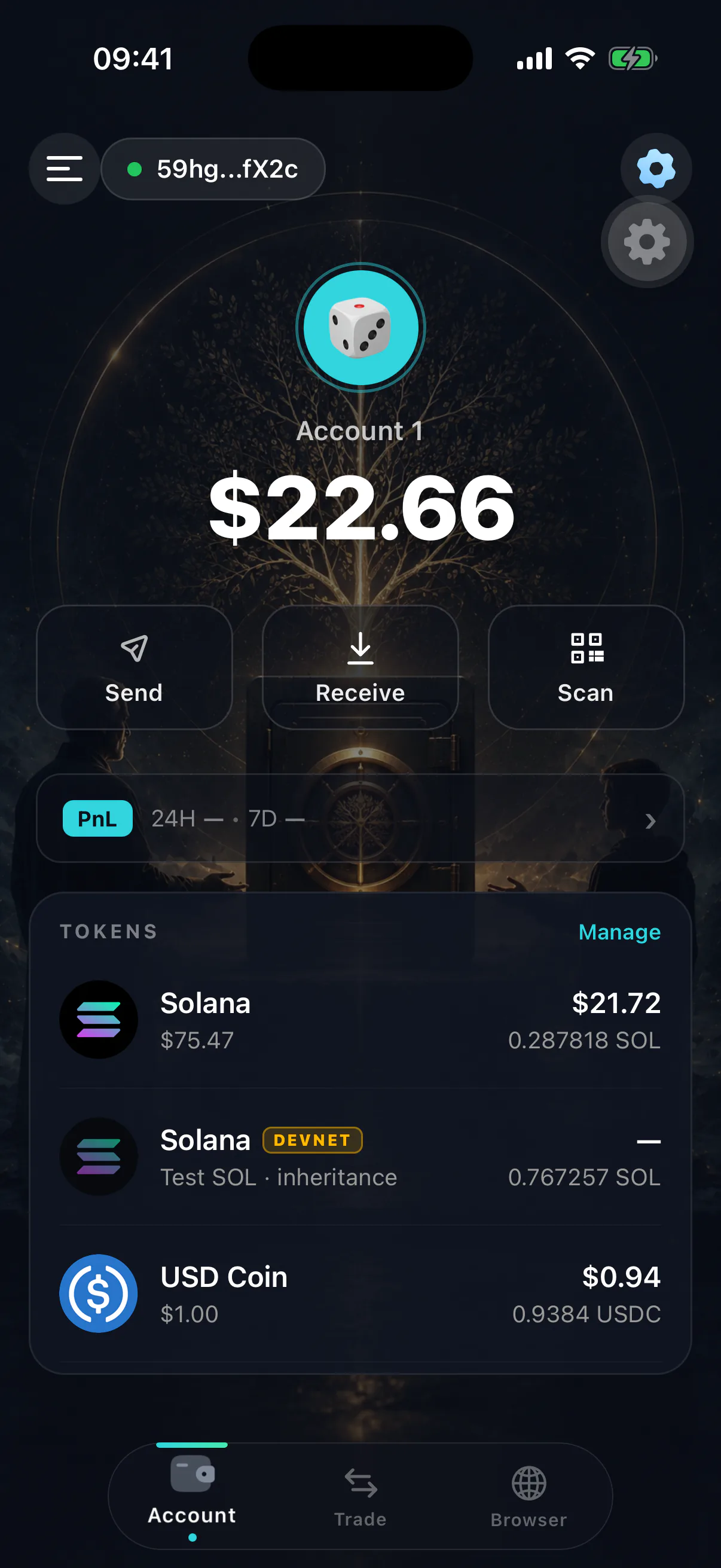
- A Solana wallet. SOL, SPL tokens and NFTs, with sending, receiving, swapping and a full transaction history.
- An inheritance system. A programmable dead man's switch that lets a person you nominate claim what you set aside for them, but only after a long silence and a challenge window you can interrupt.
- An encrypted vault. Logins, files, notes, instructions and final messages, encrypted on your device and released on the same condition.
What it is not
- Not a custodian. We cannot see your balance, freeze your wallet, recover your phrase or release your estate. Read what we cannot do.
- Not a will. The Switch moves crypto assets on a blockchain. It is not a legal instrument, it does not go through probate, and it does not override anything a court decides. Talk to a solicitor about how it fits alongside a real will.
- Not a backup service. If you lose your recovery phrase and your device, the wallet is gone. Inheritance protects your heir, not you.
- Not multi-chain yet. Solana only, today.
Where the build actually is
The wallet works. The inheritance system and Legacy Vault are in beta against Solana devnet — a test network whose tokens have no value — while the full claim lifecycle is proven end to end. Treat anything you configure today as a rehearsal, not a settlement.
Who it is for
Someone who holds crypto and has thought, at least once, about what happens to it if they are hit by a bus. That is a surprisingly under-served group: the options today are "tell someone your seed phrase" (which is a security disaster from the moment you say it out loud) or "leave it in an exchange and hope the paperwork works" (which is custody, with all the failure modes custody has).
Legacy Wallet's answer is that neither person needs to trust the other, or us, because the rules are enforced by a program that neither of you can edit.
The two roles
Almost everything in this documentation is written for one of two people:
- The owner — you set the timer, deposit assets, and fill the vault.
- The heir — you were named by someone, and one day you may need to claim.
If you were sent here because someone named you, start at you have been named an heir.
Otherwise, carry on to installing the app.