
The severity depends entirely on how far it got. Open the app first; it will tell you what happened while you were away.
Case 1 — the timer lapsed, no claim
Nothing has happened. A lapsed timer only means a claim has become possible.
Fix: open the app. The heartbeat resets your inactivity timer to zero and the window closes again.
Then work out why it happened — a lost phone, a long trip, notifications turned off — and fix that too. Consider a longer timer. See choosing your timer.
Case 2 — a claim is live
Your heir started a claim and the challenge window is running. Still nothing has transferred and the vault is still sealed.
Fix: any activity at all. Opening the app is enough; the explicit cancel action does the same thing. The claim clears and your full timer restarts. See cancelling a claim.
Then call your heir. They acted because they could not reach you. That conversation matters more than the transaction.
Case 3 — the claim finalized
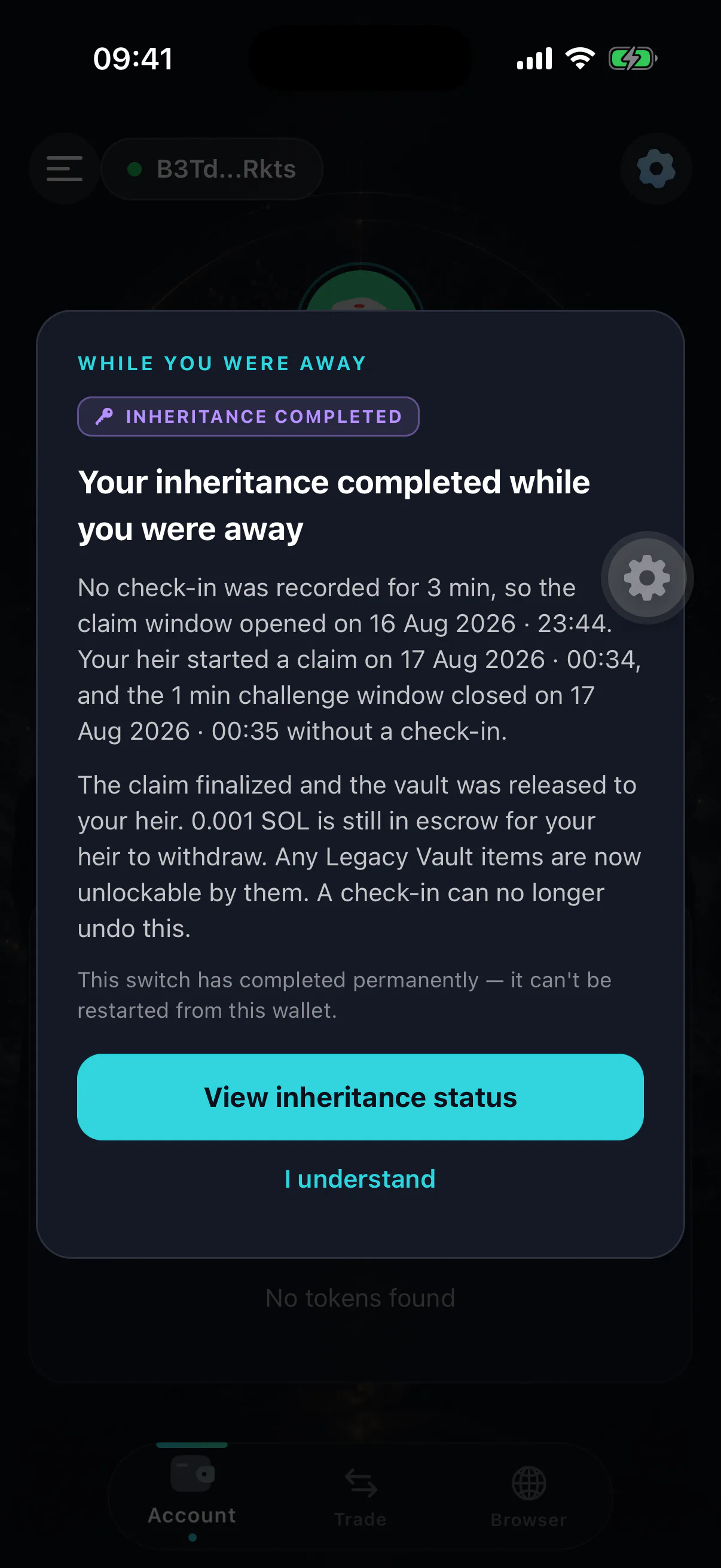
The challenge window closed without you. The estate has settled: your heir can withdraw the deposited assets, and the vault items scoped to them have become readable.
Finalization is terminal by design
It has to be. If a returning owner could undo a finalization at will, a real heir could be stripped of an estate indefinitely and nothing would ever transfer. The protection that makes inheritance reliable is the same one that makes this case awkward.
What you can do: there is an owner reclaim path that returns the configuration to a fresh state, as though the switch had never fired. It becomes available only after a grace period measured from the moment your heir could first have withdrawn — so a genuine inheritance is never disrupted by it, and a genuinely living owner is never permanently locked out.
- Requires
- Your signature. A deceased owner can never call it.
- Available
- Only after the heir's guaranteed withdrawal window
- Returns
- Unwithdrawn SOL from the inheritance vault
- Does not return
Anything already withdrawn, and deposited SPL tokens, which cannot be enumerated for return — sweep tokens before reclaiming where you can
- Does not un-release
Vault items your heir already decrypted
Assets your heir already took are theirs on-chain. No program action reverses that. It is a conversation, not a transaction.
Vault items that were released stay released. If a recovery phrase was among them, treat the associated wallet as compromised and move those funds now. See storing a recovery phrase.
Afterwards
- 01
Set your timers deliberately
If a year was too short for your life, choose two or three.
- 02
Turn notifications on
They are the warning system that exists precisely to prevent this. See warnings and notifications.
- 03
Keep SOL for fees
An address that cannot pay for a transaction cannot check in.
- 04
Rotate anything that was exposed
Passwords, phrases and accounts from any released vault items.